
A policy nobody signed for is a policy you cannot prove
The question that actually gets asked
When a complaint lands, the question is rarely "did you have a policy?" It is "can you show it reached the people it applied to, and when?"
Most small employers have the policy. Far fewer can show everyone knew about it. A handbook on a shared drive, or an email that may or may not have been opened, proves very little once someone says they never saw it.
What is changing
From 30 October 2026, the duty to prevent sexual harassment strengthens from taking "reasonable steps" to taking "all reasonable steps", under the Employment Rights Act 2025. A tribunal weighing that standard will ask what was put in place, who was told, and when.
And since 1 October 2026, the time limit for most tribunal claims has doubled from three months to six. A dispute can now arrive twice as far from the event it concerns, which is a long time to rely on memory.
The policy is the promise
Having a harassment policy, a disciplinary procedure or a flexible working policy is necessary. But a document in a handbook shows only that the business wrote something down once. It does not show that anyone read it, understood it or agreed to it.
The policy is the promise. The signed record is the proof.
The record that is easy to lose
Without a system, the proof that someone read a policy tends to live in an inbox, on a paper sign-in sheet or in a manager's memory. When that manager leaves, the proof leaves with them. A larger business has systems that outlive any one person almost by accident. A small team usually does not.
What good evidence looks like
Good evidence is made at the moment it happens, not reconstructed after a complaint. For a policy, that means being able to show the exact version the person was given, when it was assigned to them, when they opened it, when they finished reading it, and when they signed, along with what they agreed to.
How Jamie HR handles it
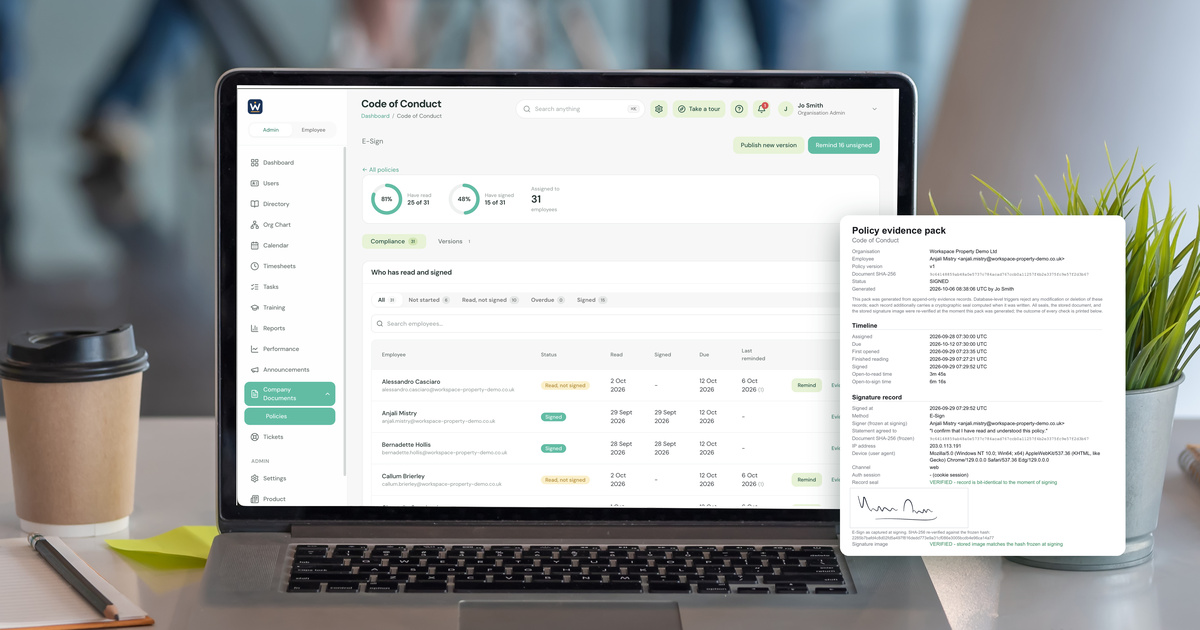
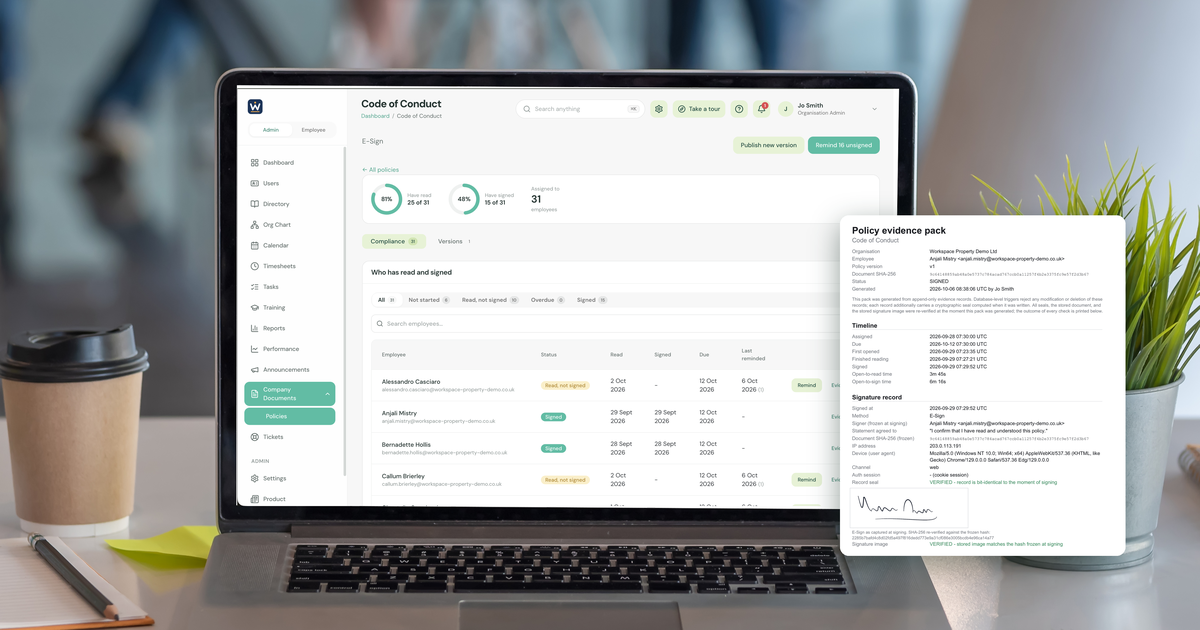
In Jamie HR, a policy is written and issued to your team from within the platform. Each person reads it and signs for it, on their phone or on a computer, and a record is saved against their staff record. You can see at a glance who has read it, who has signed it and who has not, and send a reminder to anyone still outstanding.
For each person there is an evidence pack: the exact version of the policy they were given, when it was assigned, when they first opened it, when they finished reading, when they signed, and the statement they agreed to. The record is sealed when it is written, so it can be shown to be unchanged since the moment of signing. There is no separate tool to buy. The functionality is included, with no extra charge.
A signature is one piece of evidence, not the whole defence. Training, consistent enforcement and acting on complaints still matter. But it turns "we are sure everyone saw it" into "here is the record".