Part-time, rota-based, irregular hours, inherited TUPE terms: the staff who do not fit a standard 9 to 5 are the ones whose holiday ends up calculated in a spreadsheet. Here is how to stop that.
The question
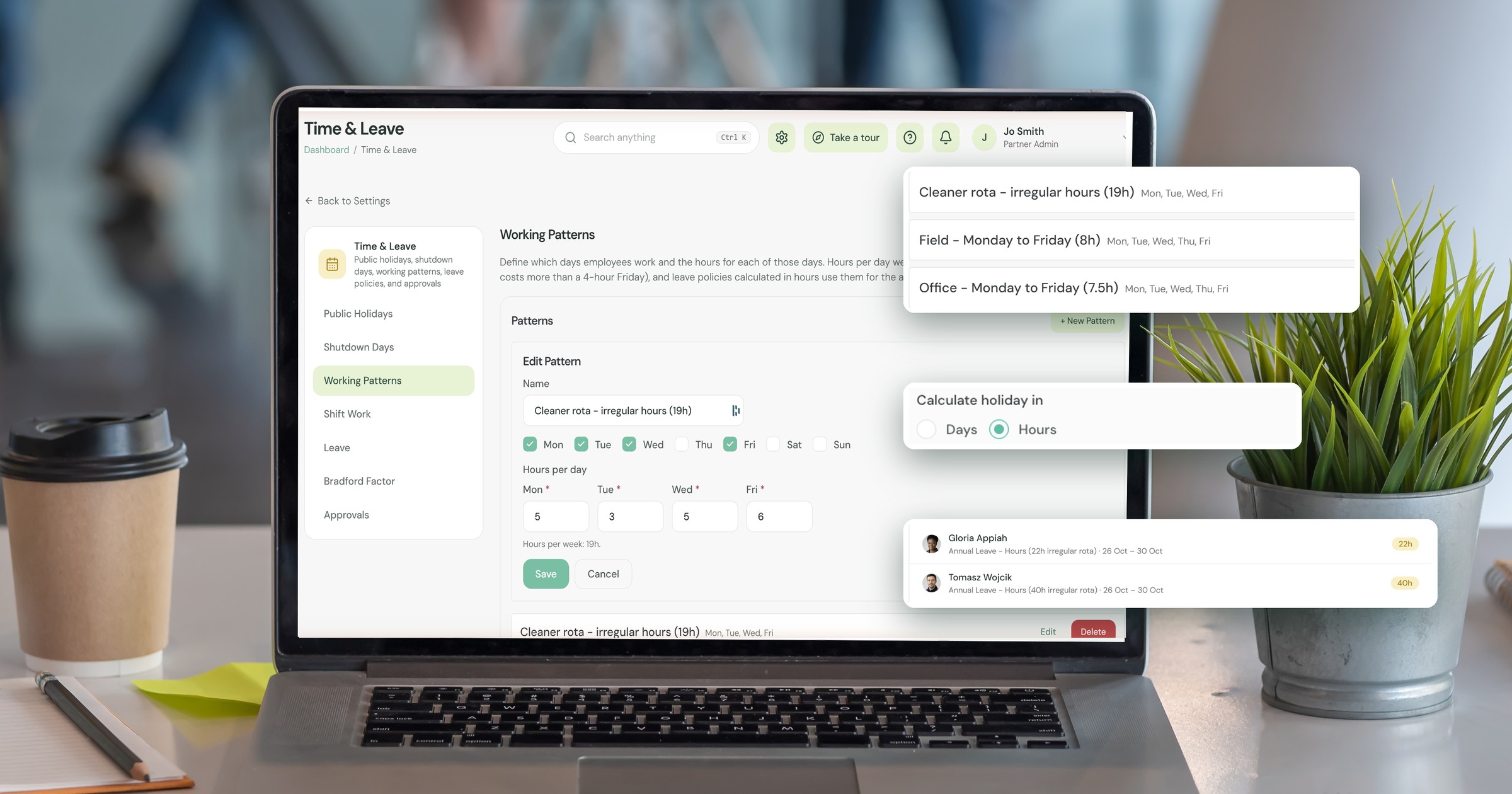
Most HR systems cope with Monday to Friday. The real test is the colleague who works five hours on Monday, three on Tuesday, five on Wednesday and six on Friday. Can your system hold that pattern, and work out their holiday from it?
The spreadsheet problem
When the system cannot, someone builds a spreadsheet. It starts as one workaround and becomes a second, unofficial record of who is owed what. It drifts out of step with the HR system, and it depends on whoever built it staying put.
Working patterns, day by day
In Jamie HR you can create as many working patterns as you need. Set the days someone works and the hours for each of those days, so irregular hours on irregular days sit inside the system. Because the pattern lives in Jamie HR, the holiday allowance is worked out there too, not outside it.
If the pattern is in the system, the holiday maths is too.
Days or hours, your choice
Jamie HR calculates holiday in days or in hours. A standard office policy can run in days, while a policy for irregular-hours staff can run in hours. Either way the allowance comes from each person's own working pattern. Leave requests show in the unit their policy uses: for example, 3 days on a days policy, or 22 hours on an hours policy.
TUPE and legacy terms
When employees transfer under TUPE, they often bring bespoke time off rules with them. Jamie HR lets you configure those rules, so they run on autopilot with no spreadsheets needed to manage the edge cases.
See it working
The quickest way to judge a system is to give it your most awkward pattern. Book a demo and we will set it up with you.
Book a demo